
In this op-ed for Globe Rhode Island, Mass Insight's Susan Lusi writes that education in Providence is in crisis and asks Rhode Islanders to support a special commission’s recommendations to move the city's schools forward. Read the full op-ed from The Boston Globe...
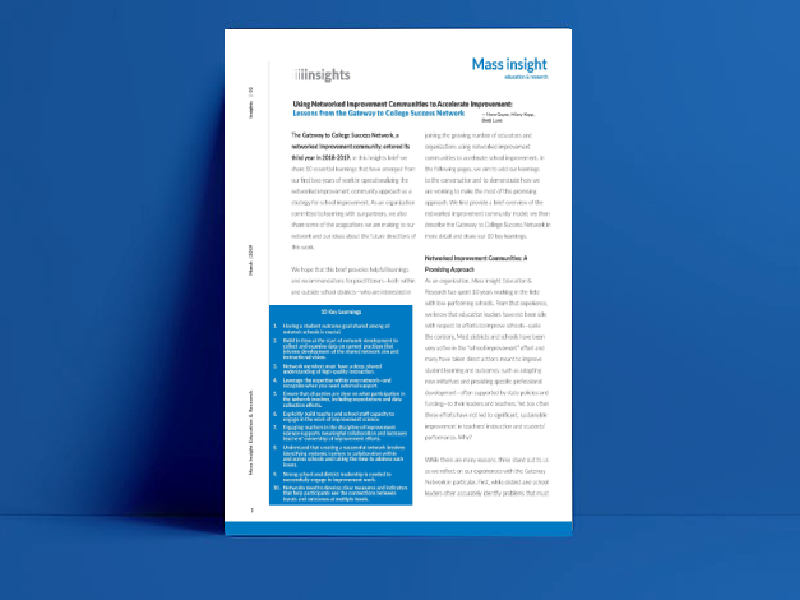
Using Networked Improvement Communities to Accelerate Improvement: Lessons from the Gateway to College Success Network
The Gateway to College Success Network, a networked improvement community, entered its third year in 2018-2019. In this Insights brief we share 10 essential learnings that have emerged from our first two years of work in operationalizing the networked improvement community approach as a strategy for school improvement.
10 Key Learnings from this Insights Paper:
- Having a student outcome goal shared among all network schools is crucial.
- Build in time at the start of network development to collect and examine data on current practices that informs development of the shared network aim and instructional vision.
- Network members must have a deep, shared understanding of high-quality instruction.
- Leverage the expertise within your network – and recognize when you need external support.
- Ensure that all parties are clear on what participation in the network involves, including expectations and data collection efforts.
- Explicitly build teacher and school staff capacity to engage in the work of improvement science.
- Engaging teachers in the discipline of improvement science supports meaningful collaboration and increases teachers’ ownership of improvement efforts.
- Understand that creating a successful network involves identifying systemic barriers to collaboration within and across schools and taking the time to address such issues.
- Strong school and district leadership is needed to successfully engage in improvement work.
- Networks need to develop clear measures and indicators that help participants see the connections between inputs and outcomes at multiple levels.
Download the Resource
Recent Posts
An Interview with Mass Insight AP Students and their Teacher
https://youtu.be/mQTeW8-sX40 We sat down with two Mass Insight AP STEM & English Program students, Ben and Chris-Ander, and their teacher, William Pellegrino, to hear about their educational journeys, their experiences in AP classes and as vocational students, and...
Mass Insight Education & Research names Andrea Wolfe President & CEO
Ms. Wolfe succeeds Dr. Susan Lusi, who will step down in June after leading the national nonprofit for eight years. April 18, 2024 – The Board of Directors of Mass Insight Education & Research has named Andrea Wolfe as the next President & CEO of the...
You may also like
Executive Summary: Revisiting The Turnaround Challenge
Our report, Revisiting The Turnaround Challenge: Lessons From the Field to Advance Pandemic Recovery in Low-Performing Schools, takes a look back at the Zone model presented in our seminal 2007 report, The Turnaround Challenge, and uses three anonymous district case...
Revisiting The Turnaround Challenge: Lessons From the Field to Advance Pandemic Recovery in Low-Performing Schools
It has long been the case that the nation’s lowest performing schools serve our highest needs students — students who are systemically marginalized by virtue of race, ethnicity, socioeconomic status, language, and/or ability. But the COVID-19 pandemic has exacerbated...
The Potential of Advanced Placement to Improve College Outcomes and Narrow Racial/Ethnic and Socioeconomic Disparities
The Potential of Advanced Placement to Improve College Outcomes and Narrow Racial/Ethnic and Socioeconomic Disparities by Dr. Sarah Phillips and Brett Lane Published online in the June 2021 Journal of Advanced Academics, this paper describes how improving AP...