In this op-ed for Globe Rhode Island, Mass Insight's Susan Lusi writes that education in Providence is in crisis and asks Rhode Islanders to support a special commission’s recommendations to move the city's schools forward. Read the full op-ed from The Boston Globe...
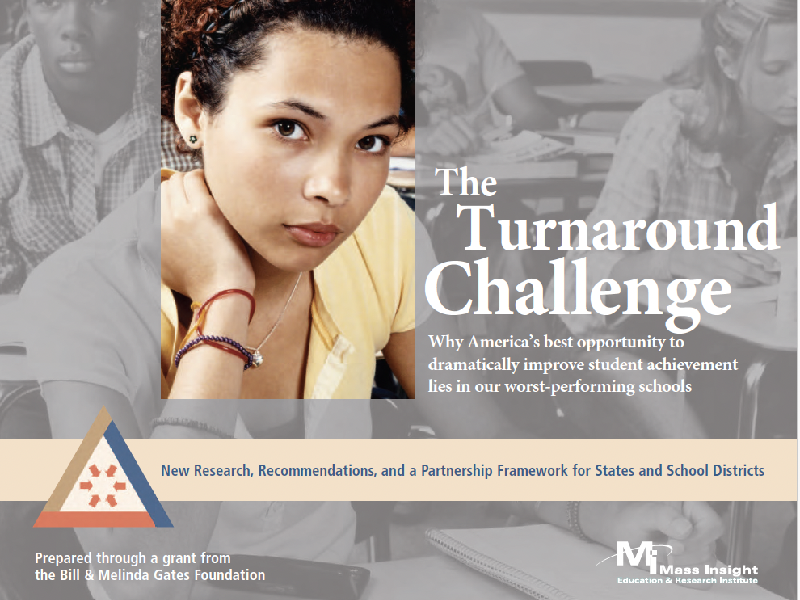
The Turnaround Challenge
The Turnaround Challenge was published in November 2007. To date, more than 200,000 copies of the main report have been downloaded, and the report’s framework is being used to develop turnaround strategies in dozens of schools, districts and states, and is informing federal policy as well.
Download the Resource
Recent Posts
An Interview with Mass Insight AP Students and their Teacher
https://youtu.be/mQTeW8-sX40 We sat down with two Mass Insight AP STEM & English Program students, Ben and Chris-Ander, and their teacher, William Pellegrino, to hear about their educational journeys, their experiences in AP classes and as vocational students, and...
Mass Insight Education & Research names Andrea Wolfe President & CEO
Ms. Wolfe succeeds Dr. Susan Lusi, who will step down in June after leading the national nonprofit for eight years. April 18, 2024 – The Board of Directors of Mass Insight Education & Research has named Andrea Wolfe as the next President & CEO of the...
You may also like
Executive Summary: Revisiting The Turnaround Challenge
Our report, Revisiting The Turnaround Challenge: Lessons From the Field to Advance Pandemic Recovery in Low-Performing Schools, takes a look back at the Zone model presented in our seminal 2007 report, The Turnaround Challenge, and uses three anonymous district case...
Revisiting The Turnaround Challenge: Lessons From the Field to Advance Pandemic Recovery in Low-Performing Schools
It has long been the case that the nation’s lowest performing schools serve our highest needs students — students who are systemically marginalized by virtue of race, ethnicity, socioeconomic status, language, and/or ability. But the COVID-19 pandemic has exacerbated...
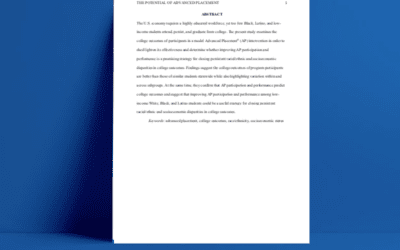
The Potential of Advanced Placement to Improve College Outcomes and Narrow Racial/Ethnic and Socioeconomic Disparities
The Potential of Advanced Placement to Improve College Outcomes and Narrow Racial/Ethnic and Socioeconomic Disparities by Dr. Sarah Phillips and Brett Lane Published online in the June 2021 Journal of Advanced Academics, this paper describes how improving AP...