
In this op-ed for Globe Rhode Island, Mass Insight's Susan Lusi writes that education in Providence is in crisis and asks Rhode Islanders to support a special commission’s recommendations to move the city's schools forward. Read the full op-ed from The Boston Globe...
The Pivot Point: Scenario Planning for Student Learning in SY20-21
School systems across the country are starting to pivot from what has been very necessary reactive crisis management to more proactive scenario planning with an eye towards SY20-21. As state education agencies, school districts, and schools start to lay out all of the possibilities, many are feeling overwhelmed.
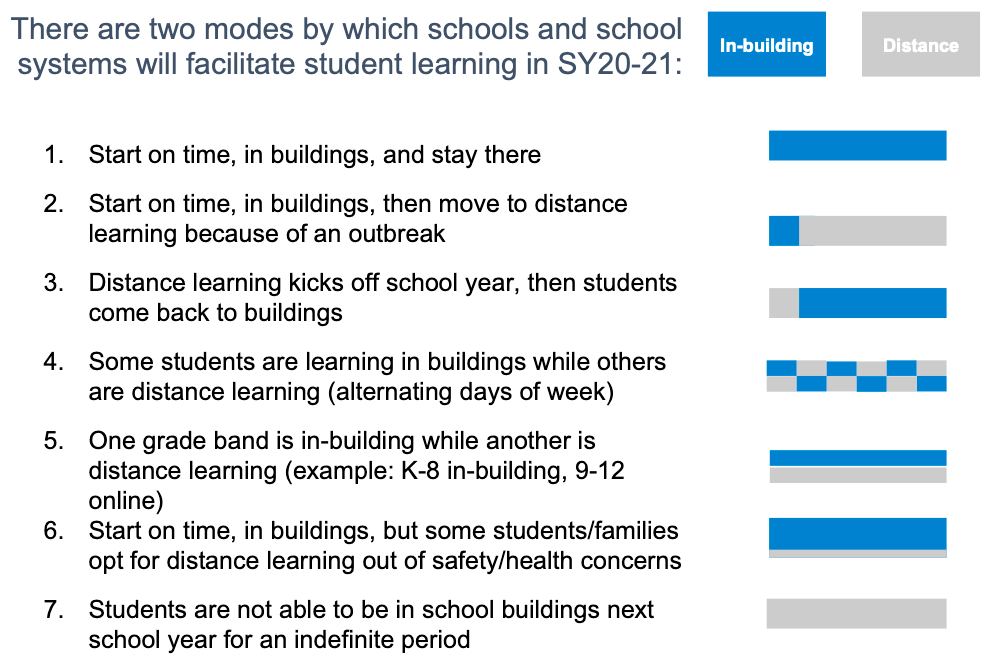
There’s a lot we don’t know about next school year. Students could come back to buildings on time, but then go out again quickly. Or perhaps not all students will come back at once: we’ll have to stagger students to reduce density and increase social distancing within school buildings. Or students will learn remotely for much of the fall. Compounding possibilities compound stress.
Here are seven of the possibilities we have been mapping out with our partners, depicted as permutations of these two modes of learning.

Here’s what we do know about next school year. We will need to facilitate student learning online, in buildings, or through some combination. Rather than despair for lack of a crystal ball, we can plan for what we do know by asking: What will need to be true for all of our students to successfully learn in buildings? What will need to be true for all of our students to successfully learn remotely? If we can answer both of these questions, we’ll be well on our way regardless of which of the above scenarios comes to pass.
We’re not advocating that anyone ignore the important differences and operational implications in these varying scenarios. But we are finding that our partners take heart and gain traction when they embrace and plan for what they do know.
This is the first of several blog posts on how Mi is helping our partners plan for an unknown future.

Recent Posts
An Interview with Mass Insight AP Students and their Teacher
https://youtu.be/mQTeW8-sX40 We sat down with two Mass Insight AP STEM & English Program students, Ben and Chris-Ander, and their teacher, William Pellegrino, to hear about their educational journeys, their experiences in AP classes and as vocational students, and...
Mass Insight Education & Research names Andrea Wolfe President & CEO
Ms. Wolfe succeeds Dr. Susan Lusi, who will step down in June after leading the national nonprofit for eight years. April 18, 2024 – The Board of Directors of Mass Insight Education & Research has named Andrea Wolfe as the next President & CEO of the...
You may also like
An Interview with Mass Insight AP Students and their Teacher
https://youtu.be/mQTeW8-sX40 We sat down with two Mass Insight AP STEM & English Program students, Ben and Chris-Ander, and their teacher, William Pellegrino, to hear about their educational journeys, their experiences in AP classes and as vocational students, and...
An Interview with Kristen Hengtgen of The Education Trust
https://youtu.be/1ZfxNShHJOU?si=d1a1GoVrgrDWT5Cu Kristen Hengtgen, Ph.D. is a senior analyst on The Education Trust's P-12 policy team and co-author of their new report, Increasing Access to Advanced Coursework in Massachusetts. In this interview, she joins Mass...

Creating the conditions for greater success of systemically disadvantaged students in AP: Next steps for the Massachusetts AP STEM & English program
Recently the New York Times published an article entitled, Why is the College Board Pushing to Expand Advanced Placement? The article focuses on an important issue: there’s been greater growth in AP participation for Black and Latino students and students living in...